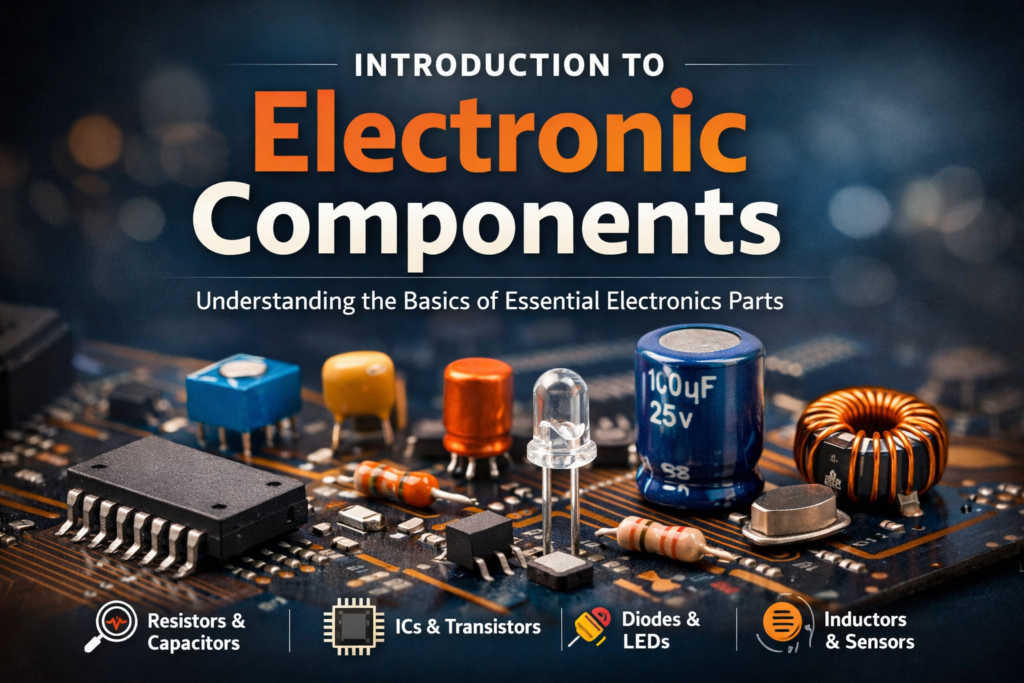
Electronic components are the building blocks of all modern electronic devices—from smartphones and laptops to industrial machines and smart home systems. Understanding these components is essential for anyone interested in electronics, engineering, or technology.
In this article, we’ll explore the most common electronic components, their functions, and how they work together in electronic circuits.
What Are Electronic Components?
Electronic components are individual parts designed to control the flow of electricity in a circuit. Each component has a specific role, such as limiting current, storing energy, switching signals, or processing data.
When combined on a printed circuit board (PCB), these components create functional electronic systems.
Common Types of Electronic Components
1. Resistors
Resistors regulate the flow of electrical current by providing resistance. They are commonly used to protect sensitive components, divide voltages, and control signal levels.
Key uses:
-
Current limiting
-
Voltage division
-
Signal conditioning
2. Capacitors
Capacitors store and release electrical energy. They are often used to smooth voltage fluctuations, filter noise, and provide temporary power storage.
Key uses:
-
Power supply stabilization
-
Signal filtering
-
Energy storage
3. Diodes and LEDs
Diodes allow current to flow in only one direction, protecting circuits from reverse polarity. LEDs (Light Emitting Diodes) are special diodes that emit light when current passes through them.
Key uses:
-
Rectification
-
Circuit protection
-
Visual indicators and lighting
4. Transistors
Transistors act as electronic switches or amplifiers. They are fundamental to modern electronics and are used extensively in signal processing and power control.
Key uses:
-
Switching circuits
-
Signal amplification
-
Power regulation
5. Integrated Circuits (ICs)
Integrated circuits combine multiple electronic components into a single chip. They perform complex functions such as processing, memory storage, and control operations.
Key uses:
-
Microcontrollers
-
Logic processing
-
Communication systems
6. Inductors and Sensors
Inductors store energy in a magnetic field and are commonly used in power supplies and signal filtering. Sensors detect physical changes such as temperature, motion, or light and convert them into electrical signals.
Key uses:
-
Power conversion
-
Signal filtering
-
Environmental detection
How Electronic Components Work Together
Electronic components are mounted on PCBs and connected by copper traces to form circuits. Each component interacts with others to achieve a specific function—whether it’s amplifying a signal, controlling power, or processing data.
A well-designed circuit ensures efficiency, reliability, and safety.
Why Learning Electronic Components Matters
Understanding electronic components helps you:
-
Troubleshoot and repair devices
-
Design your own electronic projects
-
Make informed decisions when sourcing components
-
Improve technical and engineering skills
Whether you’re a beginner or a professional, mastering the basics of electronic components is a valuable skill.
Final Thoughts
Electronic components are the foundation of today’s technology-driven world. By learning their functions and applications, you gain deeper insight into how electronic devices work and how innovation continues to evolve.
If you’re starting your journey into electronics, mastering these components is the perfect first step.